
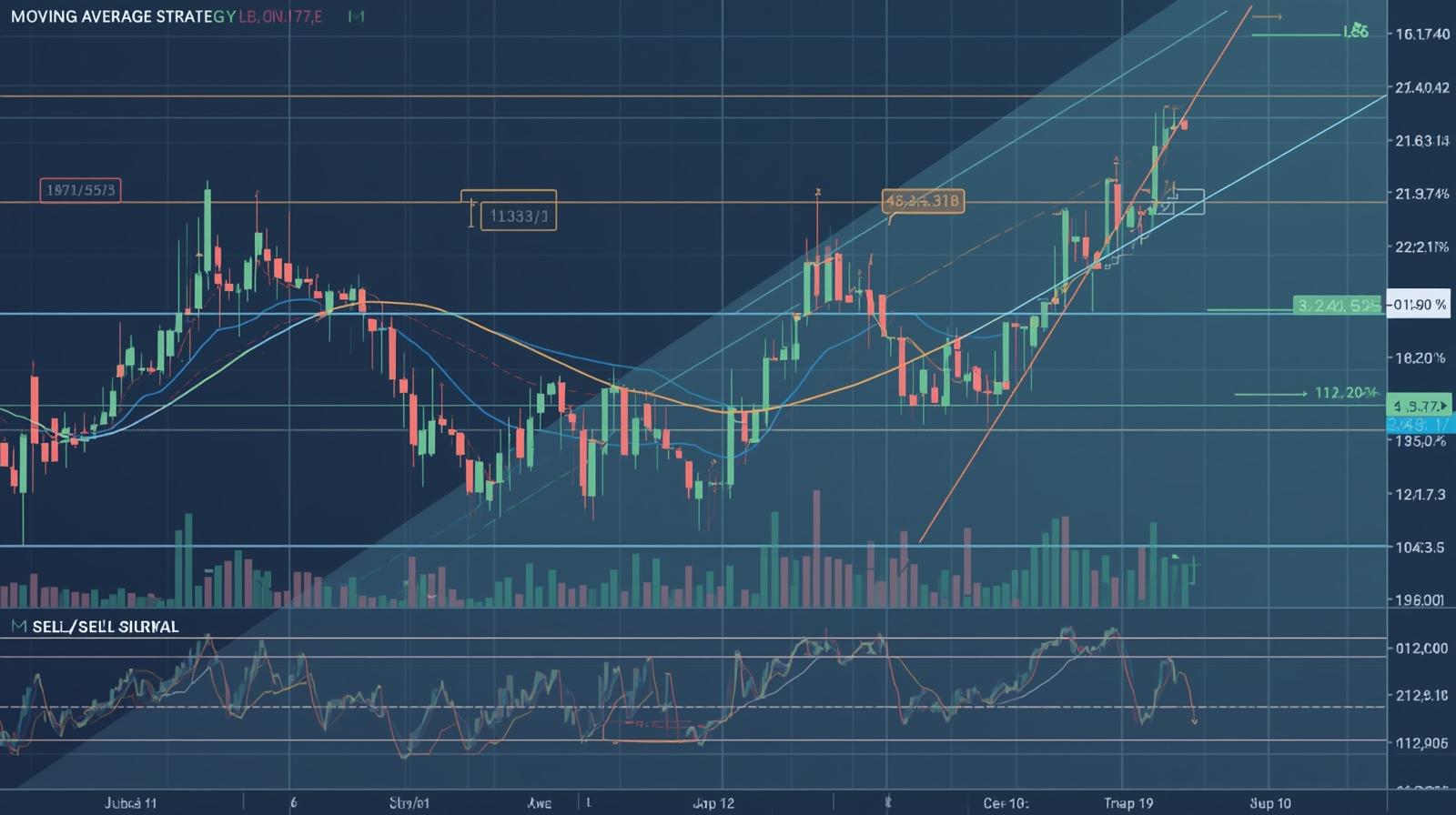
Moving Average Strategy is one of the simplest and most effective trading methods that helps traders spot trends, entry points, and exit opportunities. Learn how to use the Moving Average Strategy for consistent results.

Moving Average Strategy: 5 Proven Ways to Trade Successfully
Trading strategies are crucial for becoming a successful trader, and one of the most common techniques is the Moving Average Strategy. Both beginners and experienced traders use this approach because it is simple, reliable, and fits various financial instruments such as stocks, forex, and commodities. When used properly, the Moving Average Strategy provides clear insights into price direction, helping traders avoid emotional decisions.
In this article, we will look at the Moving Average Strategy, its main components, different methods of use, and practical tips to make it work better in live markets.
What is the Moving Average Strategy?
The Moving Average Strategy relies on the moving average indicator, which smooths price data over a set time period. By averaging historical prices, moving averages eliminate short-term price swings and reveal the overall market trend. Traders use this strategy to see if the market is moving up, down, or sideways.
There are two main types of moving averages used in this strategy:
- Simple Moving Average (SMA): or SMA, finds the average of closing prices for a set number of time periods.
- Exponential Moving Average (EMA): Gives more weight to recent prices, making it more responsive to current market events.
Both are important for effectively applying the Moving Average Strategy.
Why Use the Moving Average Strategy?
The biggest benefit of the Moving Average Strategy is its clarity. Instead of relying only on intuition, traders use it to confirm the trend direction. For example, if the price is above the moving average, the bias is bullish. If the price is below it, the bias is bearish. This simple rule makes the Moving Average Strategy very practical for both new and seasoned traders.
Some key benefits include:
- Finding potential entry and exit points.
- Acting as dynamic support and resistance levels.
- Reducing market noise and highlighting the overall trend.
- Improving consistency in decision-making.
Types of Moving Average Strategy
The Moving Average Strategy has several forms, and traders often tailor it to fit their individual style, time frame, and risk level. Below are some popular variations:
1. Single Moving Average Strategy
This is the simplest version, where one moving average line is added to a chart. Traders buy when the price crosses above the moving average and sell when it crosses below. This method works best in trending markets.
2. Double Moving Average Strategy
This version uses two moving averages, typically one short-term and one long-term. A common combination is the 50-day SMA and the 200-day SMA. A buy signal occurs when the shorter moving average crosses above the longer one, known as a “golden cross.” Conversely, a sell signal happens when the short-term average crosses below the long-term one, called a “death cross.”
3. Triple Moving Average Strategy
Using three different moving averages helps traders filter out false signals. For example, combining 10-day, 50-day, and 200-day averages can confirm trend strength. This version of the Moving Average Strategy is more reliable in sideways markets.
4. Moving Average Crossover Strategy
This method focuses on entry points that occur when two or more moving averages intersect. It gives traders strong visual signals of trend reversals.
5. Moving Average with Support and Resistance
In this approach, the moving average acts as a dynamic support or resistance line. Traders enter long trades when the price bounces above the moving average and short trades when it falls below. This is one of the most effective ways to combine price action with the Moving Average Strategy.
How to Apply the Moving Average Strategy in Trading
Using the Moving Average Strategy is easy if traders maintain discipline and proper analysis. Here are the steps:
- Choose the Right Timeframe: Day traders often use short periods like the 9 EMA or 20 EMA, while swing traders might rely on the 50 SMA or 200 SMA.
- Identify the Trend: Check whether the market is moving up, down, or sideways.
- Wait for Crossovers or Price Tests: Enter trades only when key signals align with market direction.
- Use Stop-Loss Protection: Set stop-losses just below recent swing lows in uptrends or above swing highs in downtrends.
- Combine with Other Indicators: Improve accuracy by pairing the Moving Average Strategy with RSI, MACD, or volume analysis.
Mistakes to Avoid with the Moving Average Strategy
Although the Moving Average Strategy is powerful, traders often misuse it. Common mistakes include:
- Using the same settings in all market conditions.
- Relying only on moving averages without checking volume or price action.
- Entering trades too early in sideways markets, leading to losses from false signals.
- Ignoring risk management rules.
Keep in mind that no trading method guarantees perfect accuracy. Discipline and consistent practice are key to using the Moving Average Strategy successfully.
FAQs on Moving Average Strategy
Q1. What is the best moving average for beginners?
For beginners, the 50-day Simple Moving Average is often recommended, as it provides a clear view of the medium-term trend without too much market noise.
Q2. Can the Moving Average Strategy work for day trading?
Yes. Short-term moving averages like the 9 EMA and 20 EMA are frequently used by day traders to capture quick intraday moves.
Q3. Which is better: SMA or EMA in the Moving Average Strategy?
Both have their benefits. SMA is smoother and more suitable for long-term analysis, while EMA reacts faster to price changes, making it ideal for short-term trading.
Q4. Does the Moving Average Strategy work in sideways markets?
The strategy performs best in trending markets. In sideways ranges, it can give false signals, so traders should confirm with other indicators.
Q5. How many moving averages should I use at once?
It depends on your trading style. A single moving average is good for simplicity, but using two or three can reduce false signals and confirm trend strength.
Conclusion
The Moving Average Strategy remains a fundamental part of technical trading methods because it highlights trends and provides clear trading signals. By using variations like crossovers or dynamic support and resistance, traders can significantly improve their decision-making. However, success needs proper risk management, patience, and confirmation from other tools. Whether you’re new to trading or an experienced trader, adding the Moving Average Strategy to your trading plan can be a significant step toward achieving consistent profits.
“For better technical analysis and fast, intuitive charting, check out SimpleChart, a great tool for day traders seeking reliable insights.”